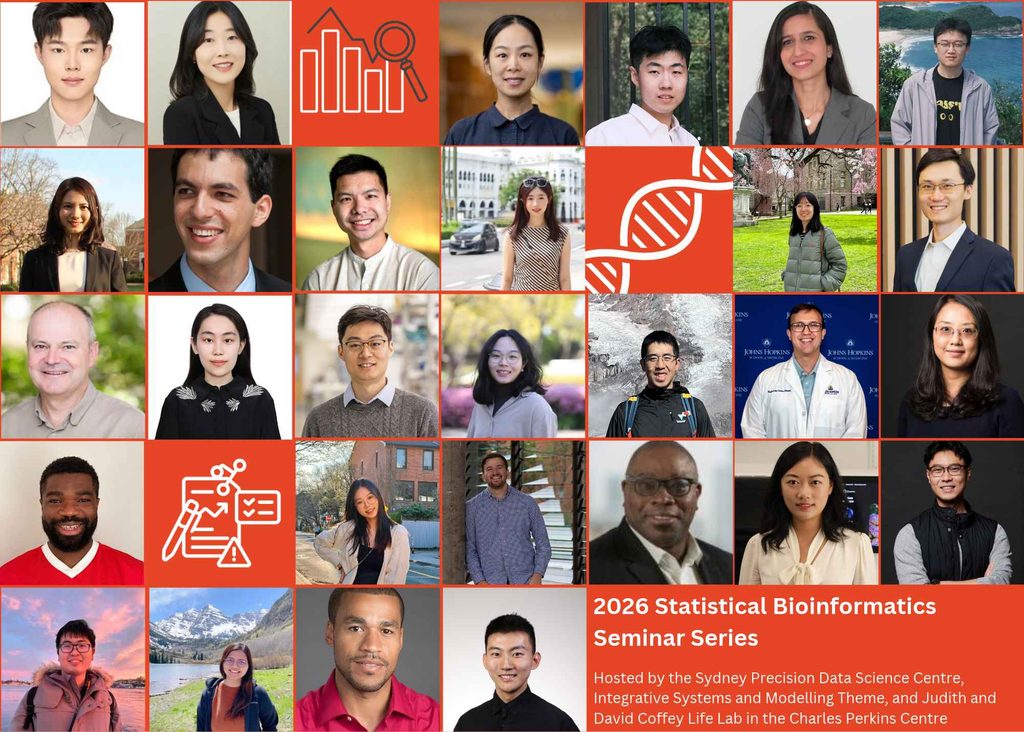
Last week, we brought our 2026 Statistical Bioinformatics Seminar Series to a close, celebrating a successful year of 27 seminars, 28 speakers, and over 800 attendances, showcasing cutting-edge research and fostering scientific exchange across the statistical bioinformatics community.
Held every Monday during the university semester, the seminar series brings together researchers from different career stages, including our Judith and David Coffey Invited Speakers. This year, we welcomed speakers from leading institutions across Australia, Asia, and North America, including 3 Professors, 1 Associate Professor, 6 Assistant Professors, 7 postdoctoral researchers, and 9 PhD students or recent graduates. Our hybrid format attracted an average of approximately 30 attendees per session, enabling both in-person and online participation.
This year’s seminars explored a diverse range of topics, spanning statistical genetics, spatial and single-cell omics, AI foundation models, and computational drug discovery. A key theme was the increasing convergence of these fields, with new computational approaches linking molecular data to biological mechanisms and therapeutic applications. In spatial omics, Assistant Professor Xiaoqing (Jade) Wang (Texas A&M University) introduced ELLA for subcellular spatial analysis, while PhD candidate Lisa Chen (Yale University) presented STORM, integrating spatial, temporal, and multimodal data to reveal dynamic gene programs. In AI-driven biomedical research, Dr Kexin Huang (Stanford University) showcased a foundation model for drug repurposing, and Dr Weize Xu (Stanford University) introduced an evolvable multi-agent framework for automated genomics discovery. Bridging statistical genetics and translational research, PhD student Han Wang presented a large-scale glaucoma GWAS integrating genetic and single-cell data to identify disease-associated genes and potential therapeutic targets.
Our four Judith and David Coffey Invited Speakers further highlighted the breadth of statistical and computational approaches in biomedical research. Professor Eric Tchetgen Tchetgen (University of Pennsylvania) introduced proximal causal inference, while Professor Sean L. Simpson (Wake Forest University School of Medicine) presented recent developments in statistical brain network analysis. Professor David Balding shared insights into statistical genetics, and Assistant Professor Boxiang Liu explored genetic variation at cellular and spatial resolution.
We sincerely thank all our speakers, attendees, seminar hosts, and organisers for their contributions to another successful year. We look forward to welcoming everyone back in 2027 for another exciting year of scientific discovery and exchange!