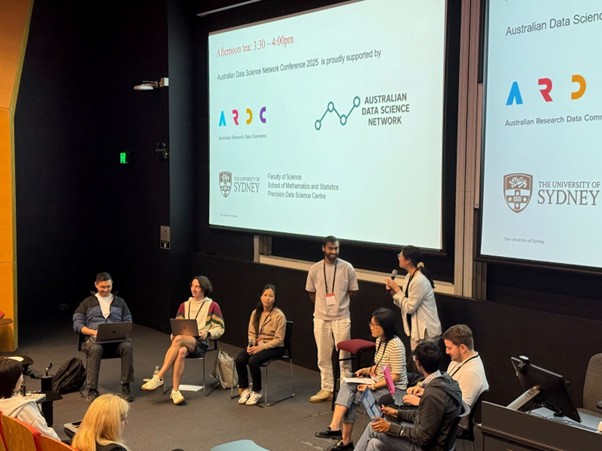

The Sydney Precision Data Science Centre was proud to host the Australian Data Science Network (ADSN) Conference 2025 at the University of Sydney from 10–12 November. Over three days, more than 100 attendees came together for keynotes, panels, and lively debates on the future of AI and data science.
The conference kicked off with a compelling keynote by Distinguished Professor Bin Yu (UC Berkeley), who introduced her Veridical Data Science framework, which aims to facilitate trustworthiness in the AI era.
One of the key highlights of day 1 was a dynamic round of fast-forward presentations, featuring 22 hashtag HDR students and ECR speakers who presented their work using one slide and within just 90 seconds. This rapid-fire format provided attendees with a glimpse of the breadth of research in Australia covering topics such as machine learning for disease prediction, robust state-space model for blue whale location-tracking, leveraging GenAI for critical thinking in Education, and the creation of an orchestration framework for multi-disciplinary research. It was wonderful to see so many young data scientists engaging with such a diverse set of problems.
Day 2 saw Karin Verspoor (RMIT University) deliver an insightful keynote on the impacts of AI on the scientific ecosystem – from NLP accelerating biomedical discovery to the ethical and infrastructure challenges ahead. There was an active ADSN workshop on Shaping the Future of Australia’s Digital Health Research Infrastructure and six brave ECRs took the stage for a fiery LLM Debate — arguing whether AI will replace or reimagine the role of scientists. This was a thought-provoking, passionate, and (thankfully) very human session.
On the final day, Yuan-Fang Li (Oracle Health and AI, Monash University) delivered a keynote on Tackling the Complexities of Electronic Healthcare Records with LLMs highlighting some of the challenges and recent work on how LLMs are being leveraged to tackle the medical coding tasks. The panel session on industry-university collaborations was a highlight for many where we heard from Jinman Kim, Dimitri Perrin, Helen Gardner, Willem Vervoort and Yuan-Fang Li about their experiences collaborating with industry.
Among the contributed talks, a particular standout was Richard Bradhurst (University of Melbourne) talking about computational modelling of black swan bioterror events, which showcased the remarkable insights made possible by the Australian Animal Disease Spread (AADIS) model, essentially a flight simulator for epidemiologists, now in use by governments in more than 20 countries.
It was also great to have many opportunities to socialise with attendees, with the welcome reception at the Courtyard Café, Holme Building on day 1 and the conference dinner at Thai Pothong on day 2.
Thank you to our sponsors: Australian Research Data Commons, Faculty of Science, and the School of Mathematics and Statistics at the University of Sydney.