

From 20-22 July 2026, we hosted the fourth annual Winter Data Analysis Challenge, bringing together undergraduate students from across Australia to tackle a seemingly simple question: Is Australia doing well?
The Winter Data Analysis Challenge is an opportunity for students to showcase their creativity, curiosity and analytical skills by investigating a complex real-world question using data. We recognise that great data science involves much more than applying algorithms. It requires thoughtful data wrangling, exploration, interpretation, and an understanding of the wider context in which data exist.
This year’s challenge attracted 89 participants, who submitted 59 entries at the end of the three-day challenge. We were particularly pleased to see students embracing collaboration, with many participants working in teams. As in previous years, team entries performed strongly, demonstrating the value of combining diverse perspectives and complementary skills when approaching challenging data problems.
The question for the 2026 challenge, “Is Australia Doing Well?”, encouraged participants to define their own research question and determine how best to answer it with data. Some explored Australia’s economic performance, while others focused on health outcomes, social inequality, wellbeing, public safety and other important measures of national progress.
Reflecting on the experience, one of the winners highlighted both the intensity and the rewards of the event.
“It was a challenging but also rewarding experience for my teammate and I to tackle such a broad, open-ended problem in just three days. We thought on our feet, debated on ideas quickly, and really relied on each other’s strengths to complete both a high-quality report and video documentary.” – Bowen Wu, Bachelor of Data Science student.
To support participants, we provided access to data from the Organisation for Economic Co-operation and Development (OECD). However, students were also encouraged to seek out additional data sources and develop their own approaches. The resulting projects demonstrated impressive creativity, technical capability and critical thinking.
“The creativity shown by participants was exceptional. The best analyses built a compelling story layer by layer, connecting their findings to broader social and demographic trends. I was particularly impressed by projects that took an original approach to defining the question, demonstrating that good data science starts with asking thoughtful questions.”
- Dr Yue Cao, 2026 Judging panel
We would like to extend a big thank you to our sponsors, Westpac and Canva, whose support for innovation and learning helped make the challenge possible.
Congratulations to our winners!
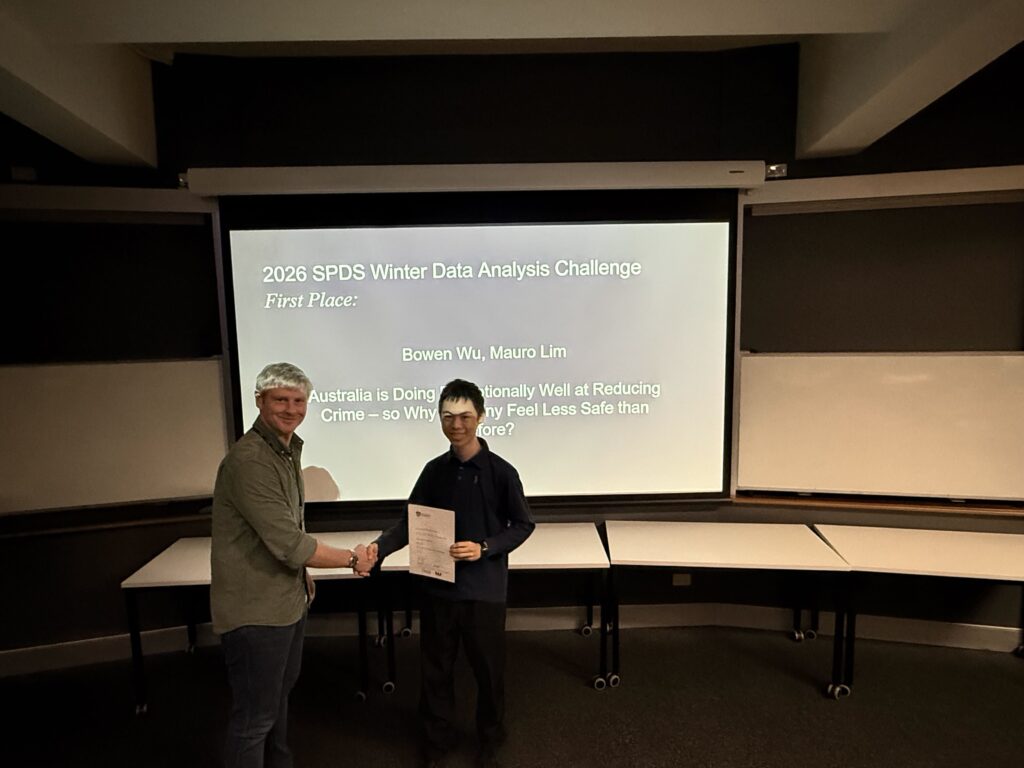
1st Place – Bowen Wu and Mauro Lim
Australia is Doing Exceptionally Well at Reducing Crime – so Why Do Many Feel Less Safe than Before?
2nd Place – Wendy Doan
Is Australia Doing Well? Aggregate Improvement, Distributional Divergence
3rd Place – Ayush Singh and Devang Jindia
Is Australia Turning Economic Capacity into Safe, More Connected Lives
Honourable Mentions
Hayley Tran, Yilin Li and Winnie Qiu
Material Progress and Social Well-Being in Australia: A Comparative Assessment
Kye Cvetkovski
Beyond Economic Recovery: Has Australia’s Wellbeing Recovered Since COVID-19?
Janis Chan
To What Extent are Improvements in Economic Prosperity Associated with Improvements in Societal Well-Being in Australia?
Lana Ilic and Filip Ilic
How Well is Australia Doing with Melanoma?